I would like to address a few of the prominent myths I've come across in my dealings with the modern Traditional Witchcraft community. The vast majority of modern Traditional practitioners are well-educated on magical history and have a firm understanding of where their practices come from. However, there is a certain subset who, unaware of magical history, have discarded or belittled genuinely ancient magical beliefs and technology in the mistaken assumption that it is "New Age." It is the mistaken beliefs about these practices I would like to address here. This is by no means an exhaustive list, but it does focus on the most prominent misunderstandings and misconceptions I have come across. I will include a list of references and suggested works at the end of this article.
1. "Gerald Gardner introduced Ceremonial Magic to Witchcraft. "Real" Witchcraft is not Ceremonial."
This mistaken belief is often found in proponents of what I call "The Grandmother In The Woods" belief. Similar in some respects to other "Magical Grandmother" tales (once quite popular in the modern Pagan Witchcraft scene) this legend claims that traditional magic used no set system of practices and was, in fact, made up by the practitioner as they went along. This seems to be a reaction to the supposedly overly ritualistic praxis of initiatory covens and sects, but is there any truth in this? By and large, no. Far from being merely "good thoughts" or "sending energy," actual surviving spells and charms from history instead indicate a set list of procedures, Words of Power, and an established Craft that was passed down via oral training and the limited magical books available. It does not show a system that was made up by each individual practitioner. Again and again we find such time-honoured techniques such as the use of poppets and dolls, magical word squares (the "SATOR" square appears again and again) herbalism, and practices drawn from the Medieval grimoires. One of the few surviving spellbooks of an English "Cunning Man" named Arthur Gauntlet contains, not the simplistic candle burning spells and positive thinking of modern eclectic magic, but material drawn straight from "the Key of Solomon" and other such texts and relying heavily on complicated rituals, though turned to more practical ends. Even American works such as John George Hohman's "Long Lost Friend" are full of magical words and prayers taken from much earlier texts. Clearly, then, the line between what we think of as "Ceremonial Magic" and "Witchcraft" is much less defined than some would have us belief, and this has been true for centuries before the birth of Gerald Gardner. To be sure, Gardner drew upon such works as the previously mentioned "Key of Solomon" in his creation of Wicca, but in doing so he merely drew from the same well as earlier magical systems; he was far from being the first Witch to do so.
2. "Using crystals and stones in magic is "New Age" and not traditional."
This belief is easily proven false. Stones and gems have been believed to have magical powers for thousands of years. The Bible contains references to many precious stones being used in a ritual context, and throughout the Middle Ages rulers, kings, astrologers, and physicians drew heavily upon the alleged powers of different precious and semi-precious stones. The Amethyst was believed to help prevent drunkenness. Lapis Lazuli appears in Sumerian texts as being related to the Gods. The Elizabethan astrologer John Dee (along with Edward Kelley) used a mirror of Obsidian and a "shew stone" to speak with angels and spirits. Beryl was also used during older times as a scrying instrument. Cornelius Agrippa's seminal work "Three Books of Occult Philosophy" contains a vast amount of information regarding the magical use of various gems. Published in 1531, this is clearly predates the modern ages by several centuries. While it is true that the use of crystals and gems has been seized upon (and some might say been misunderstood) by the modern New Age movement, they clearly are not the source of the lore and magical practice surrounding the stones.
3. "Timing magic around the phases of the Moon and planets is "New Age" and not traditional."
Again hearkening back to the grimoires and "Three Books of Occult Philosophy," we can see that this claim is not true. Indeed, the Medieval grimoires require much, much stricter adherence to the planetary days and hours than I have ever seen used in modern practice. While there is some truth in the claim that uneducated, rural magical practitioners were probably not aware of the movements of most planets, the same cannot be said of the Moon. Anyone with eyes to see can view the phases of the Moon with ease, and for millennia the Moon has been credited with magical powers and its movements closely watched. "Three Books" has a long list of various gemstones and herbs associated with the Moon and which could be used for their Lunar influences. There is a very long magical tradition of performing "growth" magic in the Moon's waxing stages and "diminishing" magic during its waning ones. Even old farmer's almanacs list the various stages of the Moon during the various months, and these were relied upon when it came time to decide when to plant (the Moon's powers were thought to influence plant growth.) An associated myth I sometimes hear is "Traditional Witches do things when they are necessary and do not care about the Moon or planets." This, to me, makes about as much sense as "Traditional farmers plant seeds whenever they feel like it and ignore the seasons and growing stages." While it is true that in an emergency any kind of magic can be performed without waiting for the proper Lunar and planetary cycles, in general it makes much more sense to wait for the right conditions than to attempt spells during the wrong astrological conditions.
4. "Traditional Witches worshiped only a Horned God. Witch Goddesses are an invention of Wicca."
There is both some truth and some falsehood to this one. It does seem likely that many Witches of the Middle Ages onwards (and certainly up until the Witchcraft revival of the '30s/'40s) focused on a Horned God of some kind (sometimes known as "The Devil.") However, earlier Witches were associated, not with a God/Satan, but with a Goddess of some kind. Greek mythology gives us Circe the witch/sorceress, described as the daughter/priestess of Hecate, the Goddess of witchcraft. The Cult of Diana existed well past the introduction of Christianity, and as late as the 10th century the "Canon Episcopi" claimed that "some wicked women, perverted by the Devil, seduced by illusions and phantasms of demons,
believe and profess themselves in the hours
of the night to ride upon certain beasts with Diana, the goddess of the Pagans, and an innumerable multitude of women,
and in the silence of the dead of the night to traverse great spaces of earth, and to obey her commands as of their mistress,
and to be summoned to her service on certain nights." Even after Europe had been thoroughly Christianized, Goddess figures lingered on in the guise of "the Queen of the Fairies," or "Mother Holle" or "The Elder Mother." The Witches in "Aradia: Or, The Gospel of the Witches" were claimed to have worshiped both Diana and her brother/lover, Lucifer. Regardless as to how much of "Aradia" is a record of an actual surviving Witch cult (and I have heard convincing arguments for both yea and nay) it does indicate that even up unto recent times (but prior to Gerald Gardner) Diana and other Goddesses were still associated with magic and Witchcraft.
5. The Wand, pentacle, magical knife, magic circle, etc are modern Wiccan inventions and not traditional."
I have already addressed this mistaken belief in detail in a few other posts, but suffice it to say that these magical tools far, far predate modern Wiccan practice. Circe in Greek myth changed Odysseus's men into pigs with a wave of her wand, and ancient wands have been discovered in Scandinavian burial mounds and Egyptian tombs alike. The Pentacle/pentagram has been used for thousands of years in various guises and was at one time a Christian symbol as well. Modern use of the pentacle and magical knife spring from the grimoire tradition, and the magical circle likewise has a very long history. The shape of the circle itself, with no beginning or end, has long been associated with Divinity of various kinds as well as protection. Circles of standing stones in various European locales attest to how ancient the use of circles in magic and religion really is.
For further reading about authentic historical magical practices, the reality of "dual faith" observance in early modern Traditional Craft, folklore, and precious stones and their magical use I recommend the following resources:
"Traditional Witchcraft: A Cornish Book of Ways" by Gemma Gary
"Three Books of Occult Philosophy" by Henry Cornelius Agrippa
"Canon Episcopi"
"The Black Toad: West Country Witchcraft and Magic" by Gemma Gary
"Modern Wicca: A History from Gerald Gardner to the Present" by Michael Howard
"The Key of Solomon" by Various
"Pow Wows; Or, Long Lost Friend" by John George Hohman
"The Grimoire of Arthur Gauntlet" edited by David Rankine

Thursday, March 14, 2013

Friday, March 8, 2013
A Traditional Witch's Besom Part 1: The Birch
I tend to take walks in the early evening around my home, and what should I find but a lot of Birch twigs fallen from a tree. Immediately I thought, "You know, I could make a traditional Witch's besom from this." I gathered up all that I could, and later went out again and got more from the surrounding streets. Keep in mind, I did not have to cut this stuff down; it had fallen naturally, and I am sure the neighbours were pleased to get some of the debris picked up from the sidewalks. I got about two big handfuls of the twigs, which I hear is the proper amount.
N ow I just need to get an Ash or Hazel wood rod to serve as the handle, and some Willow withies to bind the twigs together. The Ash might be tough; we don't have much of it up here. Hazel, however, is all about and tends to make very straight branches. Ash is a bit more traditional, but Hazel may have to do. The Willow withies I shall have to order online.
In the popular mind, Witches were said to fly to their Sabbats on broomsticks (though stangs, staffs, goats, cats, bales of hay, plants, etc were also said to serve as the Witches' steeds.) In reality, in magical lore the broomstick is usually seen as a cleansing or purifying tool, and it's not uncommon for the Witch to sweep out the ritual circle or compass before or during a rite. Traditionally, the handle was made of Ash wood for protection, the twigs were made of Birch for purification, and the Willow represented the Goddess. Now, obviously, the broom can also be seen as a phallic symbol, and the act of putting it between one's legs and "riding" it should bring to mind obvious fertility-related symbolism.
I have a broom now with an Ash handle, but its bristles are broomcorn and not birch twigs. I like the one I have, but I am happy to be making one myself and I look forward to having it done. I will keep both and use either one as the mood strikes me. I will be posting two more entries with step-by-step instructions when I get my wooden handle and Willow selected. The final result should look something like this....
 | |||
| After my first Birch gathering trip. Sorry for the bad picture quality. |
In the popular mind, Witches were said to fly to their Sabbats on broomsticks (though stangs, staffs, goats, cats, bales of hay, plants, etc were also said to serve as the Witches' steeds.) In reality, in magical lore the broomstick is usually seen as a cleansing or purifying tool, and it's not uncommon for the Witch to sweep out the ritual circle or compass before or during a rite. Traditionally, the handle was made of Ash wood for protection, the twigs were made of Birch for purification, and the Willow represented the Goddess. Now, obviously, the broom can also be seen as a phallic symbol, and the act of putting it between one's legs and "riding" it should bring to mind obvious fertility-related symbolism.
I have a broom now with an Ash handle, but its bristles are broomcorn and not birch twigs. I like the one I have, but I am happy to be making one myself and I look forward to having it done. I will keep both and use either one as the mood strikes me. I will be posting two more entries with step-by-step instructions when I get my wooden handle and Willow selected. The final result should look something like this....
 |
| Source Unknown |
Monday, March 4, 2013
On Silent Wing
I went out for a bird-watching walk this evening as the sun was setting, and I was not disappointed. As I stood quietly at the top of the hill, I saw something white take flight from a neighbouring field and head my direction. I made sure to stay completely still, and watched in awe as a Barn Owl flew not 10 feet from me. It made no noise at all, but I could see its little face and beautiful white and brown feathers. I watched the owl's path and saw it swoop down into a large grassy area (no doubt catching food) and vanish into the darkness.
Some people fear owls, but they are my favourite animal and, I think, good luck (at least for me.) Of course, the owl has a long history of being thought of as magical and mystical and is sacred to Hecate amonsgt others. I feel fortunate that I was blessed to see one in flight; because of their nocturnal habits and secretive nature, not many get to see them in their natural habitat.
Some people fear owls, but they are my favourite animal and, I think, good luck (at least for me.) Of course, the owl has a long history of being thought of as magical and mystical and is sacred to Hecate amonsgt others. I feel fortunate that I was blessed to see one in flight; because of their nocturnal habits and secretive nature, not many get to see them in their natural habitat.
Sunday, March 3, 2013
Walking the Land, Knowing the Spirits
I've spent a few days this week away in a rural area outside my city. It used to be largely farming land, and there are still many farms, but there's been a lot of new building and small communities of homes popping up. Fortunately, these on the whole are tasteful and work with the land instead of against this; a far cry from Texas, where the goal seemed to be to destroy and pave over as much of Nature as possible.
I've spent quite some time on my own, walking about and exploring my surroundings, and have been amazed at the wide variety of animal life and magical trees there are, to those who have the eyes to see them. Perhaps it's because of the land's relatively unmolested state that I feel the spirits are especially welcoming to those who seek to learn from them. As I have walked between the wise Hazels and powerful Alders I felt outside myself and could feel the spirits of the soil awakening from their long winter slumber; as indeed Spring is on the way. There is so much wisdom to be had by knowing the Land that supports you and the life that surrounds you, and this is a lesson that can never be learned from any book or training.
Enjoy these few images of my journey this week. As I return to the city I hope to take what I have learned and experienced with me, and to focus more on "doing" and less on merely "knowing."
I've spent quite some time on my own, walking about and exploring my surroundings, and have been amazed at the wide variety of animal life and magical trees there are, to those who have the eyes to see them. Perhaps it's because of the land's relatively unmolested state that I feel the spirits are especially welcoming to those who seek to learn from them. As I have walked between the wise Hazels and powerful Alders I felt outside myself and could feel the spirits of the soil awakening from their long winter slumber; as indeed Spring is on the way. There is so much wisdom to be had by knowing the Land that supports you and the life that surrounds you, and this is a lesson that can never be learned from any book or training.
Enjoy these few images of my journey this week. As I return to the city I hope to take what I have learned and experienced with me, and to focus more on "doing" and less on merely "knowing."
 |
| Farming Land |
 |
| A View of the River |
 |
| The Alder King |
 |
| The Alder King |
 |
| A View |
 |
| The Wise Hazel |
 |
| Sunset In The Country |
 | |
| The Crooked Hazel |
Sunday, February 24, 2013
A Lucky Find: Patricia Crowther's "The Zodiac Experience"
Whilst wandering around YouTube I happened across recordings of a series of astrological rituals Patricia Crowther did for the public. It's unclear when they were released; some of them seem to be older and have background music that leads me to believe they were intended for radio. Others, though, are clearly much newer. Her book "The Zodiac Experience" came out in 1991 and is still available on Amazon. I've added it to my wish list and plan on listening along with the audio materials once it arrives.
This is the first time I've ever heard Patricia Crowther speak, and she's got an amazing voice that is captivating in its brilliance. I believe she has a past as an actress, and it really shows in her exquisite reading of the rituals. I imagine she must have been an incredible High Priestess.
Here's the link to one of the videos. The others are available from the same channel. Enjoy!
This is the first time I've ever heard Patricia Crowther speak, and she's got an amazing voice that is captivating in its brilliance. I believe she has a past as an actress, and it really shows in her exquisite reading of the rituals. I imagine she must have been an incredible High Priestess.
Here's the link to one of the videos. The others are available from the same channel. Enjoy!
Friday, February 22, 2013
The Magical Hazel Tree
 Followers of my blog will well know my love of trees; the magic and folklore of trees is my big area of study, and I have wood from almost all of the main "faery" trees. I also have quite the wand collection and have them from many different woods for many different purposes. In my old home in Texas, however, it wasn't easy to come by the "best" wands woods of Hazel, Blackthorn, and Elder. In my new home, however, such trees grow all over the place and can be found in backyards, public parks, and even by the side of the road.
You can imagine my joy, then, when during my walk last week I happened across FOUR Hazel trees one street over from my new house. Even better, they had just been pruned and there was a large pile of wood that I helped myself to. Hazel is considered to be the "best" wand wood, but it's not available commercially and is quite hard to come by.
Hazel has a long history of both magical and mundane use. The nuts of the Hazel tree, of course, are edible and are used for food by both man and beast. The wood is both strong AND flexible, and was woven together to make mats that are the framework of the wattle-and-daub homes in England and elsewhere. In olden times, a wand of Hazel was a symbol of power and authority and was wielded by kings and tribal chieftains. The most notable use of Hazel, though, was for its powers of divination and prophecy. Hazel is supposed to be the best wood for dowsing, and it especially useful for finding underground veins of water. In addition, the nuts are used for divination rituals performed on Hallowe'en, where a Hazel nut was placed by the fire and its movements (either shriveling away or popping loudly) were thought to indicate one's future spouse or sweetheart. There is a very old Irish legend concerning a magical well surrounded by Hazel trees, who's nuts grant wisdom to those who eat them. The nuts fall into the well and are eaten by the salmon that live within, and those salmon were thought to give those who ate them the gift of wisdom and insight. Additionally, the famed grimoires such as the Key of Solomon suggest a wand made of Hazel or nut wood. Tradition tells us that nut and fruit trees make the best wood for magical tools, probably because they "create" something on their own.
There won't be any Hazel nuts until next Autumn, but right now the trees are covered in long fuzzy catkins and are highly visible. I'm going to go on a Hazel scouting expedition this weekend and see if I can find more trees. In the meantime, though, I have enough wood to make several wands AND a small Stang, though it will have to dry for many months before use. I'm attaching a few images of the Hazels that I found, and I hope they will make it a bit easier to identify the tree if you are not familiar with it.


Friday, February 1, 2013
My New Victorian Home
Today I'm moving yet again. I'm staying in the same town, but am leaving the condo I'm sharing with friends and moving to a Queen Anne style Victorian home that's been converted into apartments. I don't think it's any surprise to my readers that I rather prefer the old-fashioned to the modern, and it's long been a dream of mine to live in a Victorian. On a more practical level, this new place offers me easily 4 times the space I have now. With that comes a level of privacy I haven't had where I've been staying. The new place is located in the historic downtown area, and there are a lot of attractions within walking distance.
This is also going to be a lot better for my Craft work. My new home has a huge private sitting room, so I'll be able to set up a full altar and do much physically active magical rites without having to worry about running into the closet door or accidentally stabbing the wall with my magical knife. I plan on putting in special shelving to hold my herbs, incenses, and oils and will be able to have an entire bookshelf dedicated solely to my magical books. Atmosphere matters in magic, and I confess that I'll be much more "in the mood" magically in this beautiful (and a bit gothic) old home than I have been in the modern condo I'm at now.
Now, I hate moving......it's one of my least favourite things. However, I think I shall be much happier at my new place, and I am sure all the work will be well worth it.
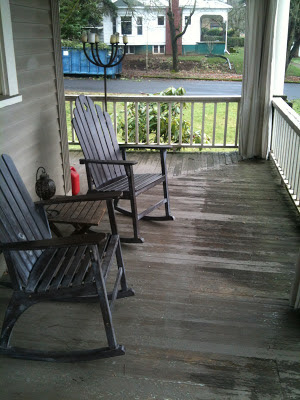
Enjoy a few images. I love the beautiful carved staircase and the wrap-around porch. It's going to be lovely drinking my morning tea out there!




This is also going to be a lot better for my Craft work. My new home has a huge private sitting room, so I'll be able to set up a full altar and do much physically active magical rites without having to worry about running into the closet door or accidentally stabbing the wall with my magical knife. I plan on putting in special shelving to hold my herbs, incenses, and oils and will be able to have an entire bookshelf dedicated solely to my magical books. Atmosphere matters in magic, and I confess that I'll be much more "in the mood" magically in this beautiful (and a bit gothic) old home than I have been in the modern condo I'm at now.
Now, I hate moving......it's one of my least favourite things. However, I think I shall be much happier at my new place, and I am sure all the work will be well worth it.
Enjoy a few images. I love the beautiful carved staircase and the wrap-around porch. It's going to be lovely drinking my morning tea out there!


Subscribe to:
Posts (Atom)